Heredicheck
Predicts hereditary disease risk with FHIR-compliant neural networks. Trains GNNs for disease prediction and integrates with healthcare APIs.
 Next.js
  Python
  Framer Motion
  FHIR
FHIR 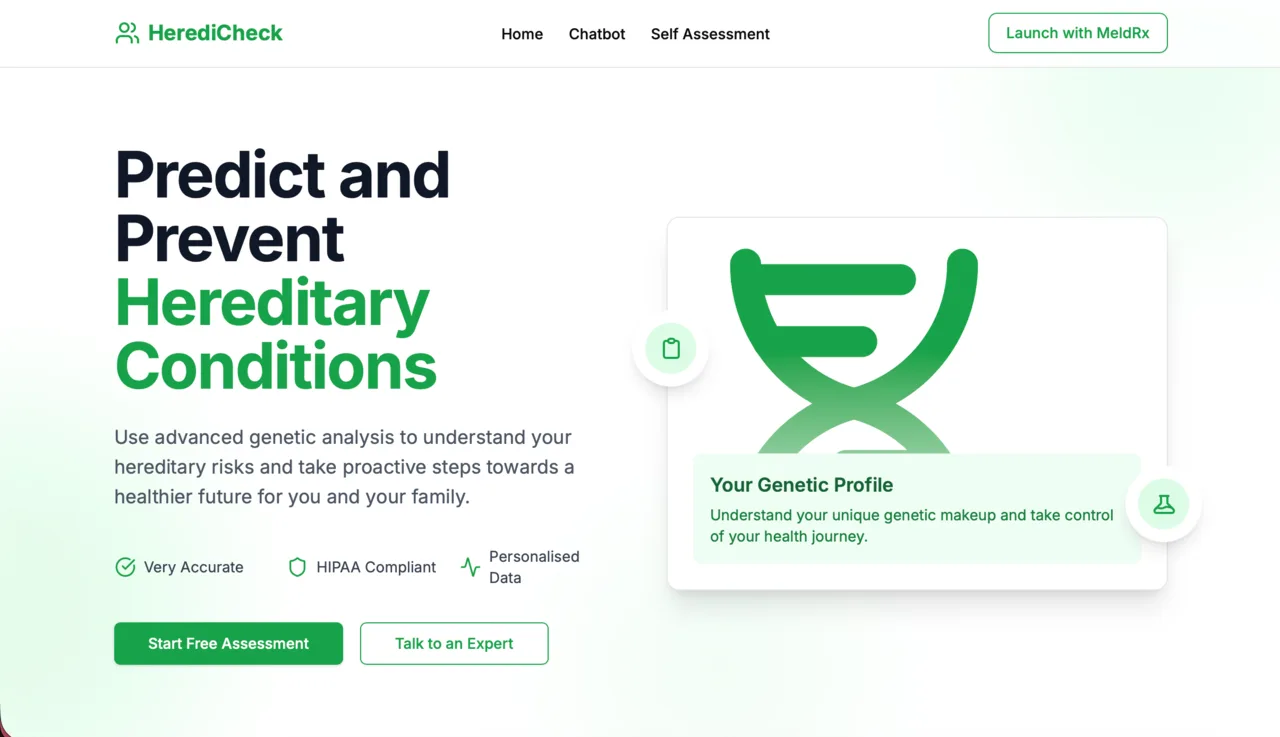
Overview
Heredicheck predicts hereditary disease risk by analyzing family relationships and medical history, and is designed to slot into real healthcare systems by speaking FHIR, the standard for exchanging health data. It was built for the Predictive AI in Healthcare with FHIR challenge and integrates directly with MeldRx, so it reads real FHIR records and writes predictions back in the same format.
The problem
Risk-prediction models are often academic prototypes that never touch a real clinical workflow because they ignore healthcare interoperability standards. A model that can’t read a hospital’s data or return results in a format the EHR understands stays stuck in a notebook, no matter how accurate it is.
What I built
- A graph neural network (GNN) pipeline that models family and genetic relationships as a graph and predicts hereditary disease risk across multiple conditions from that structure.
- FHIR-compliant data handling end to end - patient data flows in and predictions flow back out in the format real healthcare systems already speak, including a live integration with MeldRx.
- A synthetic-data pipeline built on Synthea to generate FHIR-compliant patient records, plus post-processing to recover the family connections needed to build the graph.
- A Next.js frontend with motion-driven explanations and a chatbot, so a risk score is legible to a non-technical user instead of being dumped as a raw number.
Tech & approach
A GNN was the natural fit because hereditary risk is a graph problem - risk propagates through family ties and shared genetic features, exactly the relational signal a graph network is built to capture. The model is Python, trained on Synthea-generated FHIR records, and reached 87% training accuracy with a 0.78 F1-score on the multi-label classification task (predicting several conditions at once). Real-time inference is served through a FastAPI backend; the product side is Next.js + Framer Motion.
The defining constraint was FHIR. Building to it from day one - mapping inputs and outputs to standard resources - is what lets Heredicheck slot into an existing clinical workflow rather than live as an isolated demo.
Challenges
The standards work was harder than the modelling. Understanding the FHIR API structure took real effort, and Synthea’s generated data lacked explicit family connections, so I had to build a post-processing step to reconstruct them before any graph could be trained. Training a GNN on complex, multi-label medical data and then wiring it into MeldRx’s FHIR-compliant system were each their own problem.
What I learned
Interoperability is a feature, not an afterthought. The hardest and most valuable work wasn’t the model architecture - it was making the system honestly speak the standard that hospitals use, and integrate cleanly with MeldRx. That’s the difference between a project that impresses a judge and one that could actually be deployed.
I also learned to treat explainability as part of the UI. A risk score with no context is alarming and useless; pairing the prediction with a plain-language explanation of the contributing factors was what made the output trustworthy.
What I’d improve next
- Expand disease coverage and publish proper model metrics (AUC, calibration) on a shareable benchmark so predictions can be evaluated, not just demonstrated.
- Improve AI explainability so each prediction shows which relationships and history drove it.
- Deepen EHR interoperability and optimize real-time inference performance.
Screenshots


