Cite Smart AI
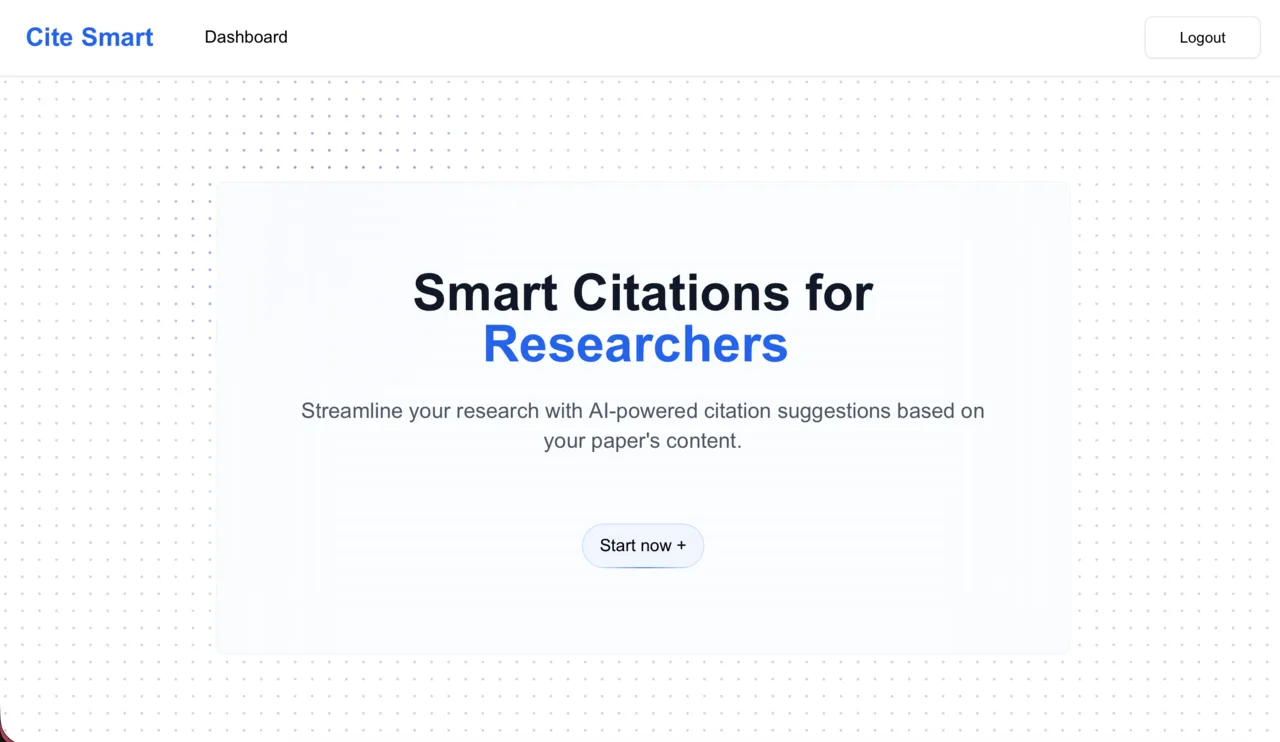
AI-powered citation explorer that visualizes paper relationships and suggests contextual citations. Built for researchers and students who need smarter, connected referencing.
 Next.js
  Tailwind CSS
  Neo4J
Neo4J  AssemblyScript
 The backend ran on Hypermode's Modus runtime. After Hypermode was acquired and its npm packages were pulled, the backend can no longer be built or run - even locally - so this project is archived as a case study.
Overview
Cite Smart AI helps researchers and students navigate the web of academic citations. Instead of a flat reference list, you search papers by title or keyword, see how they connect as a dynamic graph, and ask context-aware questions that are answered from those connected sources. Citation networks are saved per research project, so the map you build keeps growing with your work.
It was built for the Hypermode Knowledge Graph + AI Challenge, where it won Best Use of Neo4j, and was also entered in the Azure AI Developer Hackathon.
The problem
Finding the right citation is slow. Reference managers store what you’ve already found, but they don’t help you discover how papers relate to one another or surface the most relevant source for a specific claim. Researchers end up juggling search tabs, PDFs, and a reference manager that knows nothing about how any of those papers connect.
What I built
- Citation search over Semantic Scholar by title or keyword, so you can pull real papers into a project instead of starting from a blank list.
- An interactive graph view where each node is a paper and each edge is a citation, so you can literally see how an idea propagated through the literature instead of reading a flat list.
- Context-aware AI Q&A over your corpus - ask “what’s the consensus on X?” and get an answer grounded in the connected papers rather than a generic model guess.
- Saved citation networks per project, so each piece of research keeps its own evolving knowledge graph.
- A clean, fast exploration UI with authentication, so projects stay private to each researcher.
Tech & approach
The heart of the product is the graph. Paper relationships are modelled in Neo4j, which turns questions like “show me everything within two hops of this paper” into a single, natural Cypher traversal instead of a tangle of SQL joins. That graph model is what makes discovery feel like exploring a map rather than searching a database.
The frontend is Next.js + ShadCN + Tailwind, with Supabase handling authentication. The intelligence runs on Hypermode’s Modus runtime, written in AssemblyScript: DeepSeek drives citation search across Semantic Scholar, and a text-transformer model handles the natural-language understanding behind the Q&A.
The hard part was integration. AssemblyScript had a steep learning curve, GraphQL inside Modus took real wrangling, and modelling the right relationships in Neo4j was its own design problem - all while keeping a multi-service pipeline (Modus, Semantic Scholar, Neo4j) responsive enough to feel instant.
What I learned
The biggest lesson was that the data model is the product. Once citations lived in a graph, features that would have been painful in a relational schema
- shortest path between two papers, clusters of related work, “papers that cite both A and B” - became almost free. Picking the right database early paid for itself many times over.
I also learned how much coordination cost hides in stitching unfamiliar tools together. Modus, Neo4j, and AssemblyScript were each new to me, and the real work was making them cooperate without the experience falling apart - a good reminder that a correct answer buried in a clumsy interface doesn’t get used.
What I’d improve next
- Advanced search filters and citation formatting (APA/MLA/Chicago export) so it slots into a real writing workflow.
- Collaborative collections so a lab can curate and annotate a shared graph.
- Deeper AI insights - paper summaries and better visualization for very large citation graphs - plus more academic databases beyond Semantic Scholar.
Screenshots


